Family history · Source pages 202–203
Fred Sablatash Family
by Sonia Einarson
A record of a journey from the Ukraine to Manitoba, and of the life Fred and Kateryna Sablatash made near Inwood.
A family divided
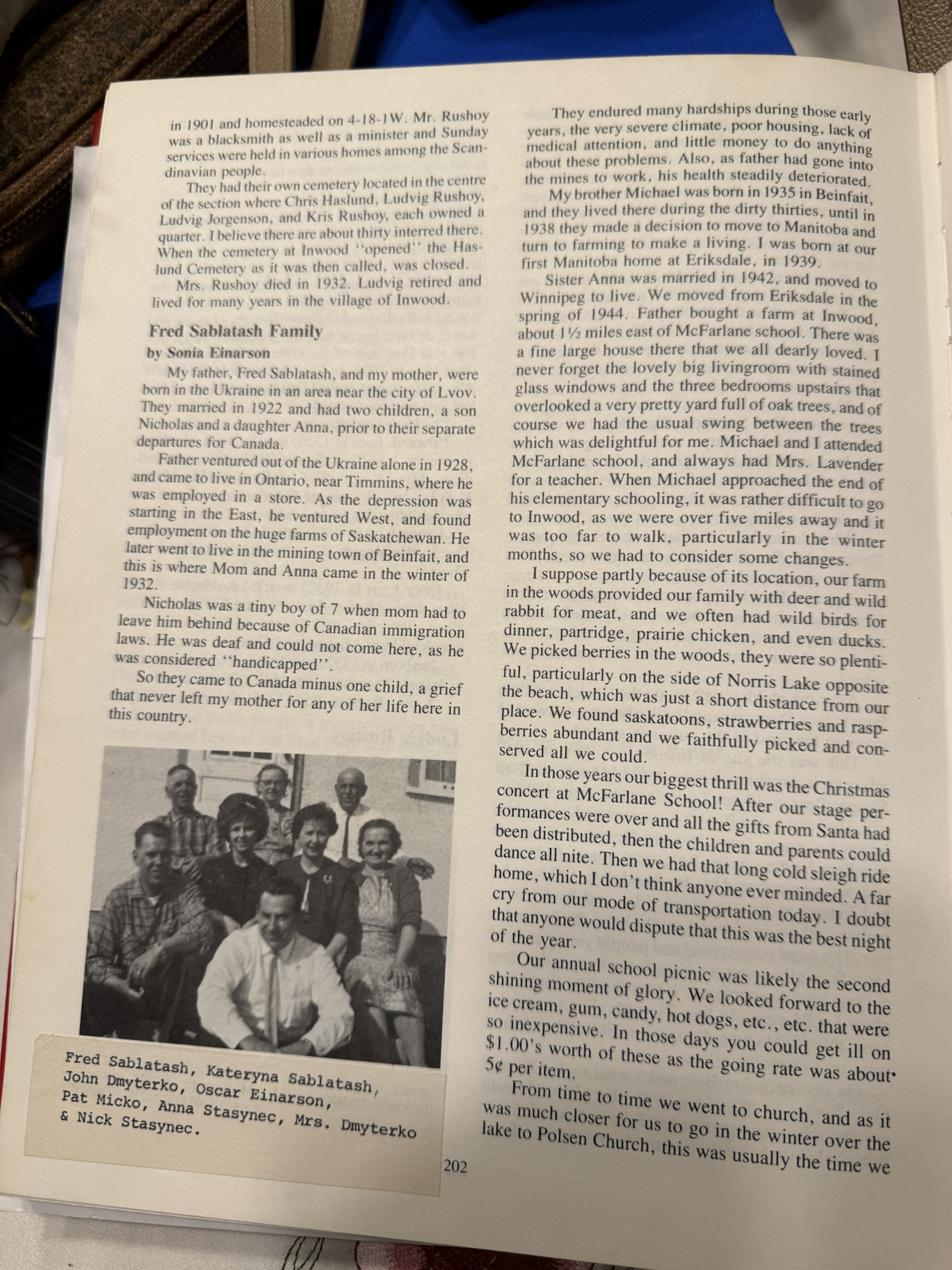
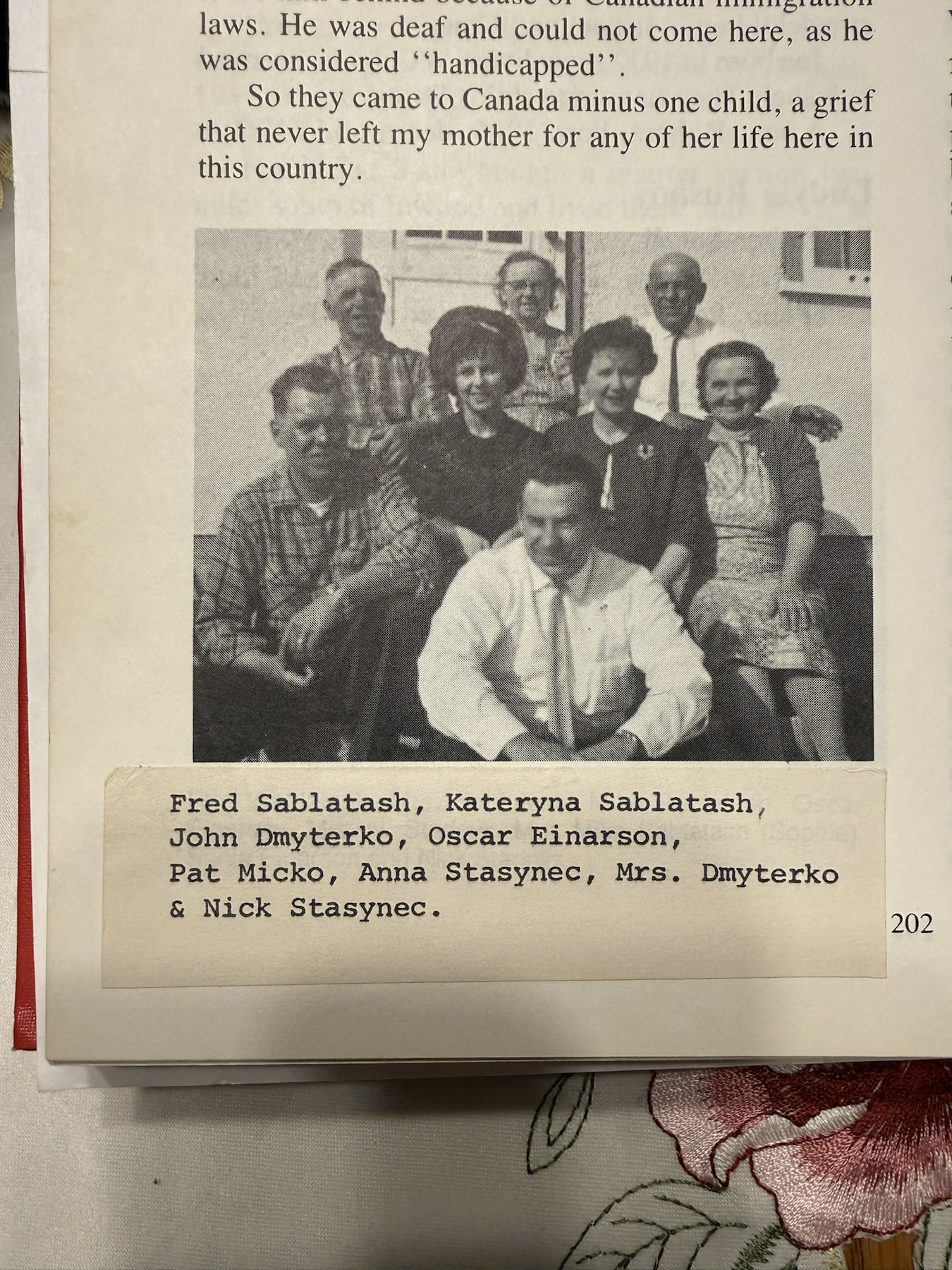
My father, Fred Sablatash, and my mother, were born in the Ukraine in an area near the city of Lvov. They married in 1922 and had two children, a son Nicholas and a daughter Anna, prior to their separate departures for Canada.
Father ventured out of the Ukraine alone in 1928, and came to live in Ontario, near Timmins, where he was employed in a store. As the depression was starting in the East, he ventured West, and found employment on the huge farms of Saskatchewan. He later went to live in the mining town of Beinfait, and this is where Mom and Anna came in the winter of 1932.
Nicholas was a tiny boy of 7 when mom had to leave him behind because of Canadian immigration laws. He was deaf and could not come here, as he was considered “handicapped”. So they came to Canada minus one child, a grief that never left my mother for any of her life here in this country.
They endured many hardships during those early years, the very severe climate, poor housing, lack of medical attention, and little money to do anything about these problems. Also, as father had gone into the mines to work, his health steadily deteriorated.
Coming to Inwood
My brother Michael was born in 1935 in Beinfait, and they lived there during the dirty thirties, until in 1938 they made a decision to move to Manitoba and turn to farming to make a living. I was born at our first Manitoba home at Eriksdale, in 1939.
Sister Anna was married in 1942, and moved to Winnipeg to live. We moved from Eriksdale in the spring of 1944. Father bought a farm at Inwood, about 1½ miles east of McFarlane school. There was a fine large house there that we all dearly loved. I’ll never forget the lovely big livingroom with stained glass windows and the three bedrooms upstairs that overlooked a very pretty yard full of oak trees, and of course we had the usual swing between the trees which was delightful for me. Michael and I attended McFarlane school, and always had Mrs. Lavender for a teacher. When Michael approached the end of his elementary schooling, it was rather difficult to go to Inwood, as we were over five miles away and it was too far to walk, particularly in the winter months, so we had to consider some changes.
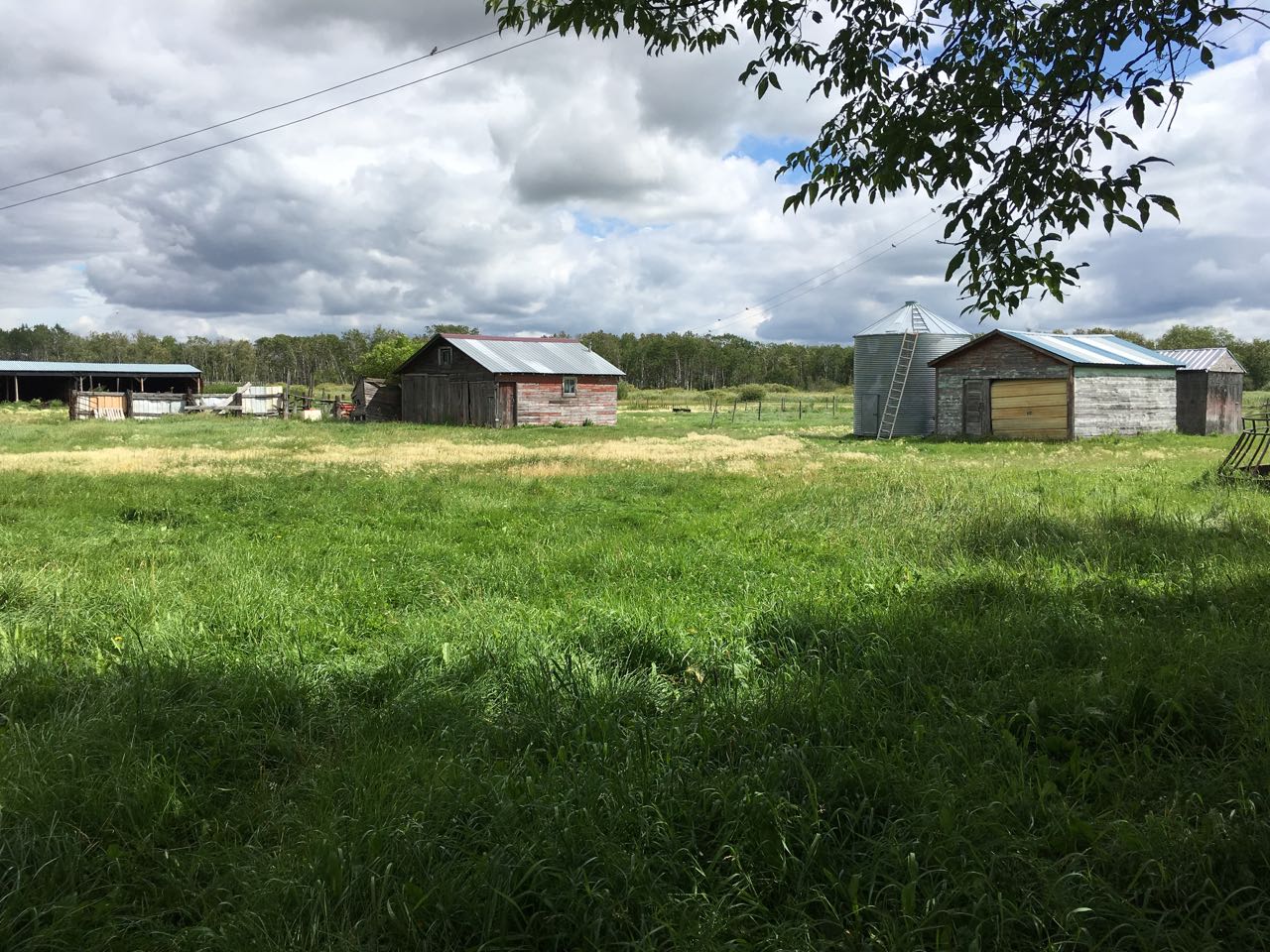
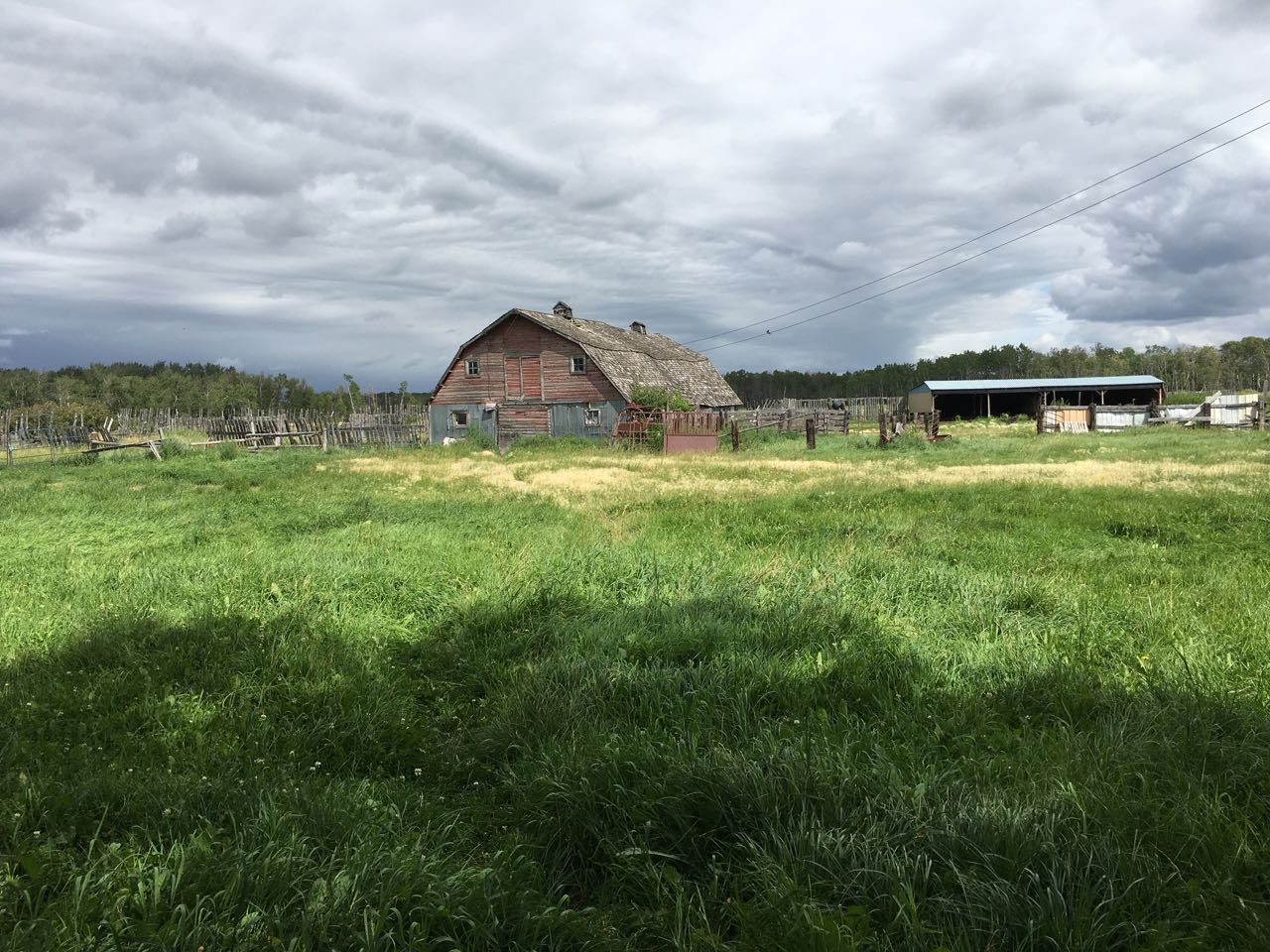
I suppose partly because of its location, our farm in the woods provided our family with deer and wild rabbit for meat, and we often had wild birds for dinner, partridge, prairie chicken, and even ducks. We picked berries in the woods, they were so plentiful, particularly on the side of Norris Lake opposite the beach, which was just a short distance from our place. We found saskatoons, strawberries and raspberries abundant and we faithfully picked and conserved all we could.
In those years our biggest thrill was the Christmas concert at McFarlane School! After our stage performances were over and all the gifts from Santa had been distributed, then the children and parents could dance all nite. Then we had that long cold sleigh ride home, which I don’t think anyone ever minded. A far cry from our mode of transportation today. I doubt that anyone would dispute that this was the best night of the year.
Work and remembrance
Our annual school picnic was likely the second shining moment of glory. We looked forward to the ice cream, gum, candy, hot dogs, etc., etc. that were so inexpensive. In those days you could get ill on $1.00’s worth of these as the going rate was about 5¢ per item.
From time to time we went to church, and as it was much closer for us to go in the winter over the lake to Polsen Church, this was usually the time we went. We had some anxious moments when the ice did not look too stable to bear the weight of the horses, the cutter and all of us. We must have had luck on our side as we never did break through the ice!
The time for change approached as access to schools became increasingly difficult. Michael was now going to Inwood and boarding near town and five miles was too far to walk twice a day. Access to the farm was limited to a mud road that was only passable by buggy and sleigh. Father had bought his first car, but we could only use it a couple of months of the year, after the snow had gone, and the rain had stopped. It was only by the grace of our good neighbours, the Enstroms, that we could get to and from our place, as the only “road” wound right through their farmyard, and we had to open and close many gates (4 or 5) before we got to the highway. Such a time to go anywhere! If we didn’t close the gates properly, surely the cattle or sheep would get out, or worse yet, mix with our own herds. Many a time this did happen.
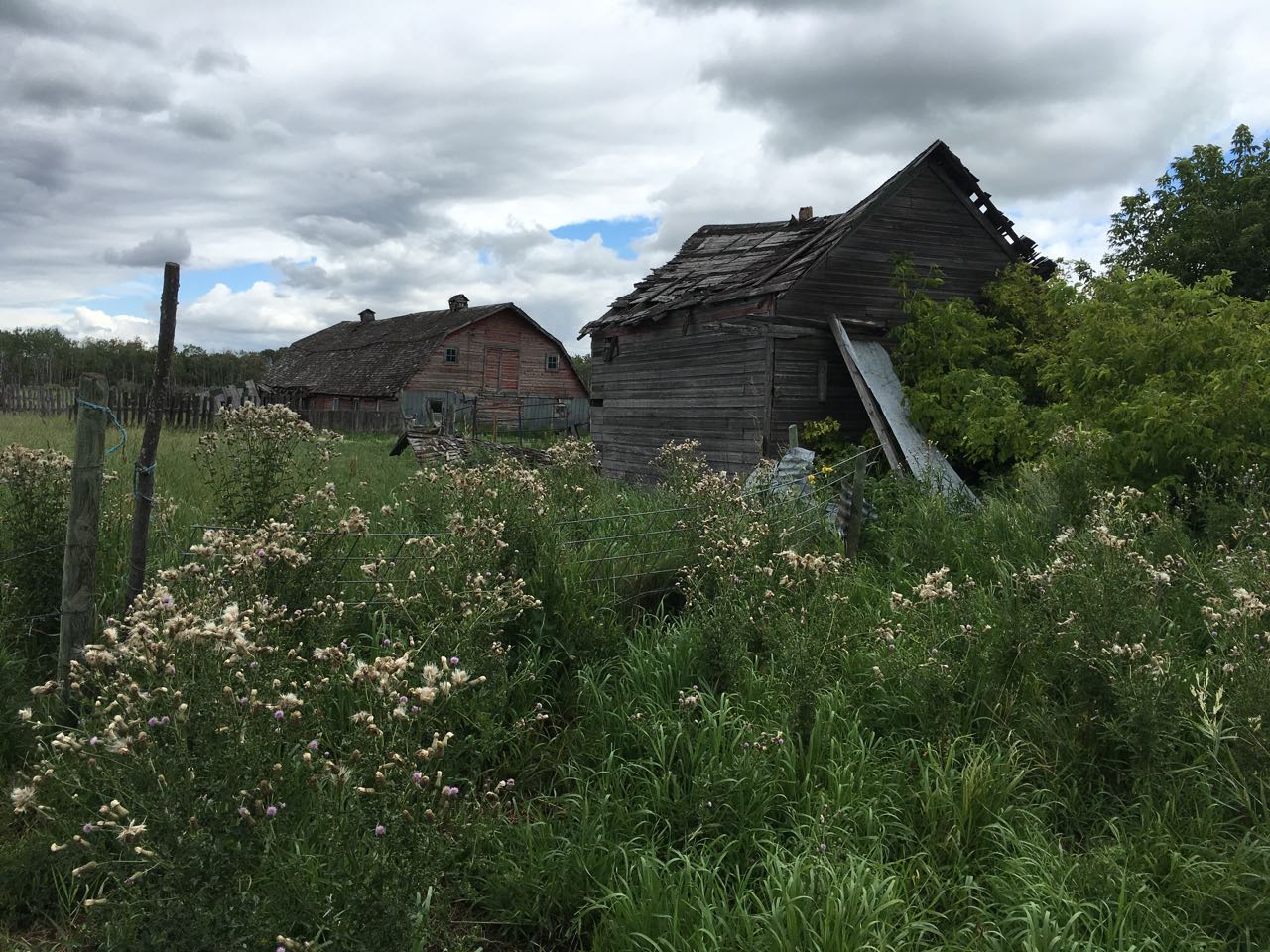
Just around 1949 we bought the farm 36-17-1W by the side of the road where Dad still lives at 75 years of age, and farms today. This was, I understand, the original homestead of the Rousseau family, and then passed on to the Meyers. We moved to this farm in 1950, after building a new barn to house our cattle.
Later years
I continued to attend McFarlane School until the end of that school year, and Michael continued to attend Inwood School. We farmed, raising a little grain and milking cows (by hand) and it’s a standing joke that when I left the farm, they had to buy a milking machine! We bought our first tractor in 1952, which incidentally is still in good order and in use. Electricity came in 1951, and with that we actually got our first refrigerator, electric iron (what a pleasure), an electric washing machine, a radio, (without batteries), and we all got a reprieve from the worst job on the farm — pumping water by hand. We had installed an electric motor and that did all that hand work for us.
Michael continued his education graduating in Electrical Engineering at the University of Manitoba in 1957 with a Master’s Degree. He then worked a few years at Northern Electric in Ottawa. He married Sophie Dmyterko in the summer of 1961. She was the daughter of Mr. and Mrs. John Dmyterko of Fisher Branch. Michael and Sophie lived at Ottawa for several years, and their children, Tanya and Loren, were born there. In the next few years, Michael obtained his Ph.D. at the University of Wisconsin, in Madison. It was there that their third child, Lisa Jennifer, was born. His studies completed Michael moved back to Canada, taking up an Assistant Professorship at the University of Toronto.
In the summer of 1971 when he and his family were on their way back home via the U.S.A. after a vacation with his parents and with Sophie’s parents, they were involved in a tragic accident in which Sophie and their son Loren were instantly killed. After this turn of events Michael and his two daughters moved to Ottawa, where Michael took up a position with the Canada Energy Board. He is a Research Scientist with them at this time.
The Einarson family
As for me, I took a less academic way through life. When I left the farm in 1955 I attended Commercial College, and after graduating in the winter of 1956, I obtained work with the Manitoba Government and worked in several capacities there for the next 8 years. I retired temporarily to raise a few children, three to be exact. We had married in 1962, my husband being the third youngest son of Einar and Svaborg Einarson of Clarkleigh. Our three daughters, Kristin, Cathy and Charlene, are all still at school.
I have since returned to work and am a Branch Secretary in the Winnipeg office of a large International Company.
My sister Anne passed away in the winter of 1974, at a rather early age. She was survived by her husband Nick, and a daughter Pat. Nick passed away in November of 1978. Pat, their daughter, lives in St. Paul, Minnesota; she is married to Jeff Micko and they have two sons, Douglas and Christopher.
Mother passed away in 1971, at the age of 70. She had lived a very full life, having seen profound changes in her lifetime, both in her surroundings and in the manner of life. She had lived through the horse and buggy days and the days of very primitive farming through the vast changes of the 40’s and 50’s, when the mechanical age really changed our lives.
Father, at 75 years of age, is still actively farming today and has a very positive approach to his ability to carry on for a long time yet.